Companies Don't Die From Losses. They Die From Receivables.
Cash is what keeps a company running. A real-world cautionary tale of losing the thread on cash flow — plus a finance-team checklist for catching the crisis early.

Ever heard the term "cash-flow insolvency"? Companies that are profitable on paper yet still go under. It happens more often than you'd think — because plenty of companies overlook something more dangerous than a loss: namely, cash flow.
You can sell your product brilliantly, but if customers don't pay on time, you can't pay your suppliers and you can't cover the cash the business needs to run. In the end, what keeps a company moving isn't "profit" — it's cash.
Today we'll talk about the blind spot in cash management that so many companies miss —
specifically, how receivables and inventory can shake a business to its core.
Case Study: Cosmetics brand "Company A" — selling well, but heading for a crisis

Company A, a cosmetics brand, manufactured via ODM and sold across multiple online marketplaces. Sales had been climbing steadily, and the company decided to seize the moment and scale up production. That's where the trouble started.
Problem 1. Suppliers' production minimums
Because the cosmetics, containers, packaging, and other components each came from different suppliers, hitting the production run meant ordering each component at or above its minimum quantity. The result: they produced a bit more than they were selling. No immediate issue — but inventory and cash pressure started building.
Problem 2. The marketplaces' settlement cycles
The product was selling well, but the online marketplaces all settled on different schedules. When one large marketplace in particular stretched its settlement cycle from one month to three, it created a major bottleneck in cash flow.
Problem 3. Cash crunch from delayed settlements
Production costs had already been incurred, but the sales proceeds weren't coming in. Payments to the container, packaging, and cosmetics manufacturers slipped, and the company started covering costs with short-term loans.
Problem 4. A competitor enters
A few months later, a competing brand launched a similar product and went aggressive on marketing. Sales velocity dropped noticeably, and the product already manufactured began piling up as inventory.
As these problems compounded, Company A — even with revenue rising — watched its cash dry up, landing right on the doorstep of so-called "cash-flow insolvency."
A checklist for catching cash-flow warning signs (feat. FP&A)
Start by checking these five items.
✅ Cash-flow crisis checklist
Item | What to look at |
|---|---|
1. Days sales outstanding (DSO) | How much does a change in settlement cycle delay cash coming in? |
2. Projected monthly cash-in / cash-out | Identify when gaps open up between payment dates and inflow dates |
3. Inventory turnover and inventory-to-asset ratio | Where is cash tied up as a result of overproduction? |
4. Settlement terms by vendor / channel | Diagnose whether a specific channel is creating a bottleneck |
5. Trend in short-term borrowings | Are you leaning on credit to handle the cash crunch? |
What if Company A had checked these five metrics?
It could have seen the timing gap between cash inflows and outflows in advance and gotten ahead of the problem by proactively adjusting production volumes and payment schedules.
Looking a little closer:
+ Metric-based response strategy, summarized
Phase | Metric | What to check | Possible response |
|---|---|---|---|
Predict the crisis | Days sales outstanding | Forecast delayed cash inflow from a change in settlement cycle | Adjust the timing of production and marketing investment |
Monthly cash-in / cash-out | Identify the gap between payment timing and inflow | Secure short-term liquidity or redesign the spending plan | |
Work the solution | Inventory turnover and inventory-to-asset ratio | Early detection of overproduction / over-purchasing | Run promotions and other inventory-clearing strategies |
Settlement terms by vendor / channel | Analyze how fast cash comes back by channel | Lean into the faster-settling channels | |
Trend in short-term borrowings | Gauge reliance on credit | Adjust the cost structure / re-time investments |
Some problems were probably unavoidable — but
if the company had been tracking metrics like these, it wouldn't have been gasping through a "cash shortage" crisis.
Numen and CBOOK connect all of these metrics.
The essential, hands-on metrics for diagnosing cash-flow and inventory risk — bring Numen and CBOOK together and you can see them all within a single flow.
Solution | Capability / metric | Description |
|---|---|---|
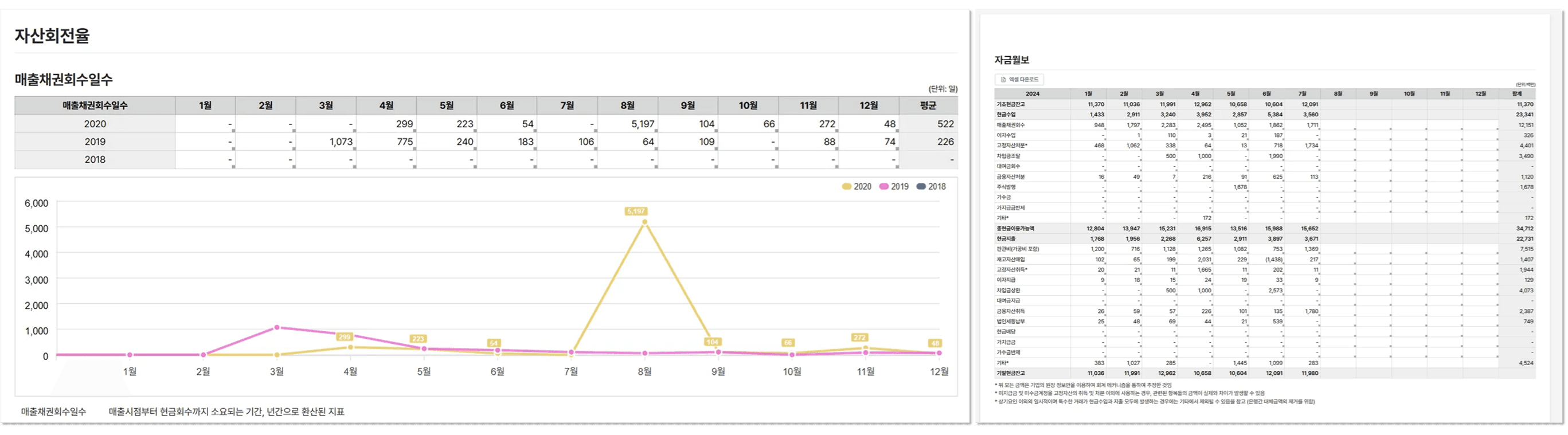
Numen | KPI analytics report → asset turnover | ▸ Inventory turnover ▸ Average collection period for receivables |
KPI analytics report → monthly treasury report | ▸ Trend in opening/closing cash balances ▸ Monthly cash inflow vs. outflow comparison | |
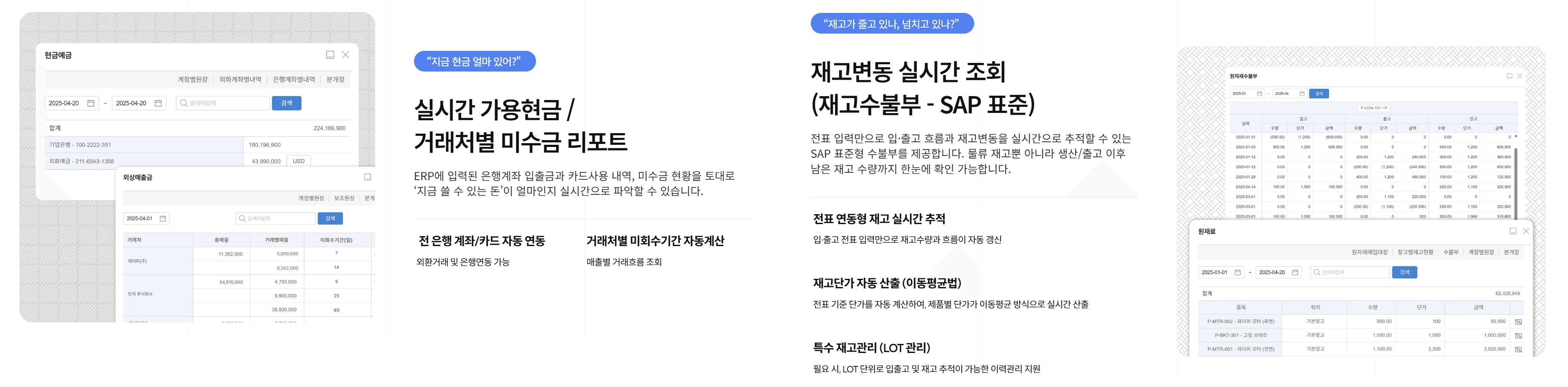
CBOOK | Days outstanding by customer | ▸ Collection period by customer ▸ Receivables-risk diagnosis |
Inventory ledger | ▸ Compare current stock vs. safety stock ▸ Real-time read on overstock / shortage |
A company can have the capacity to grow, but without the stamina, it won't finish a long race.
To make your company's cash a constant rather than a variable, you need a finance system that detects the warning signs and responds before they hit.
With Numen, the ERP-based FP&A solution, and CBOOK, the integrated management ERP, you can see it coming and respond in time. Aicy, the financial-data company, will be the pacesetter for your long race.
✨⚙️ Manage the risk of profitable-but-insolvent failure with AI!
Get FP&A insights validated on the floor — delivered every Tuesday morning.