What Is EBITDA? The Complete Guide to Profitability and Cash Flow
EBITDA has become one of the most talked-about metrics in investing and finance.

EBITDA has become one of the most talked-about metrics in investing and finance lately. It's one of the first numbers investors, CFOs, and leadership teams reach for when sizing up a company's profitability and growth.
Take Tesla: in Q4 2023, net income came in below expectations, yet EBITDA stayed strong — and the market took it well. Investors read it as a sign that the underlying operating business was still solid.
In this piece, we'll break down what EBITDA is, why it matters, and how to actually use it in running a business.
What is EBITDA?
EBITDA stands for Earnings Before Interest, Taxes, Depreciation, and Amortization — in other words, operating earnings before interest, taxes, depreciation, and amortization are deducted.

A company's fixed costs are a mix of items it actually pays out in cash and items that are non-cash.
Depreciation → recognized as the value of tangible assets (equipment, machinery, and the like) declines over time.
Amortization → recognized as the value of intangible assets (brands, patents, licenses, and so on) declines over time.
Because these non-cash costs don't involve any actual cash outflow, stripping them out lets you calculate the pure, cash-based operating earnings a company generates from its core operations. In short, EBITDA is a useful gauge of a company's underlying operating performance.
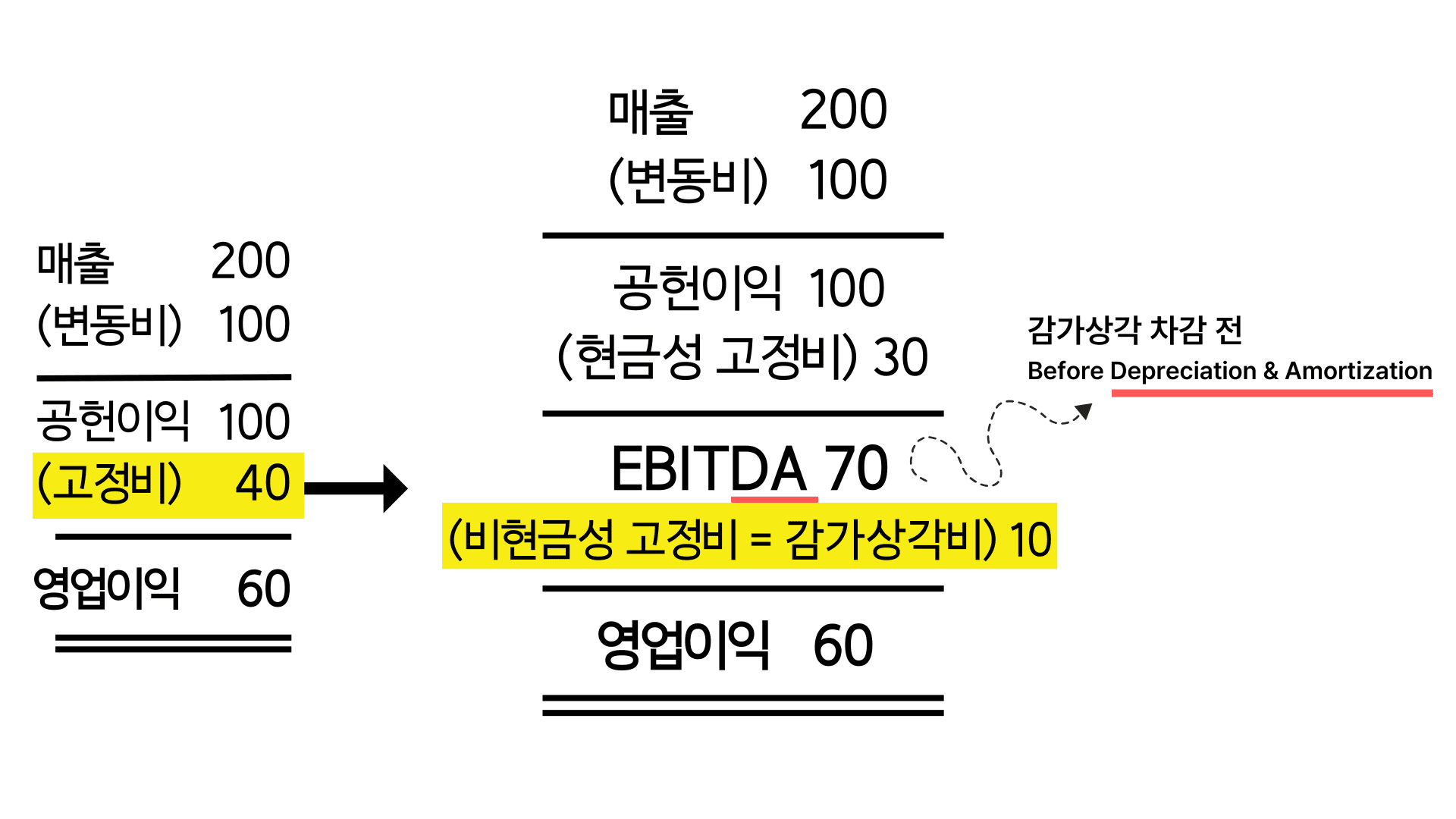
Here's an example:
A company's net income: ~$100K
Interest expense: ~$20K
Taxes: ~$10K
Depreciation: ~$30K
Amortization: ~$20K
➡️ EBITDA = ~$100K + ~$20K + ~$10K + ~$30K + ~$20K = ~$180K
So while this company's net income is ~$100K, its core operations actually generated ~$180K in cash.
The EBITDA formula:
EBITDA = net income + interest + taxes + depreciation + amortization OR
EBITDA = EBIT + depreciation + amortization
Why EBITDA matters
EBITDA isn't just net income — it's a measure of a company's real earnings power.
1. It's useful for assessing operating performance
Net income can swing on external factors like debt and taxes. EBITDA looks only at the earnings generated by operations, so it gives you a clean read on underlying operating performance.
Example:
Tesla's net income fell, but EBITDA held up → the operating business itself was solid.
2. It makes cross-company comparison easier
Because tax positions and capital structures vary from company to company, net income alone makes it hard to compare performance. EBITDA strips those variables out and measures pure operating performance.
Example
Company A carries a lot of debt, so its net income is low.
Company B carries little debt, so its net income is high.
But if their EBITDA is similar, you can treat the two companies' operating performance as equivalent.
3. It's useful in M&A
In M&A, what matters is real cash-generating ability.
Because EBITDA excludes non-cash costs (like depreciation), it's useful for projecting the cash flow you'll see post-acquisition.
In M&A markets, the EV/EBITDA multiple is widely used to value a company.
Does EBITDA have limits?
EBITDA is a powerful performance metric, but it isn't perfect.
🚫 It ignores depreciation
Depreciation isn't a cash outflow, but it does signal that asset values are declining. Judge asset health on EBITDA alone and you can get it badly wrong.
🚫 It doesn't reflect financing costs or capital structure
If a company carries heavy debt and large interest expense, EBITDA can look strong even when actual cash flow is thin.
Here's how to use EBITDA
EBITDA is an important window into a company's "real profitability" and "cash-generating ability." But because it doesn't capture depreciation or capital structure, you'll get a far more accurate read by analyzing it alongside other metrics — cash flow, net income, and operating income. Look at them together.
EBITDA Definition: https://www.investopedia.com/terms/e/ebitda.asp
EBITDA vs. EBIT: https://www.netsuite.com/portal/resource/articles/financial-management/ebit-ebitda.shtml
Insights like these, every week.
Get FP&A insights validated on the floor — delivered every Tuesday morning.