[Reader Q&A] We think our company is being valued too low. Are there financial metrics we should be managing?
Which valuation model actually fits your company? A strategic breakdown of the core metrics that win investors over.
![[Reader Q&A] We think our company is being valued too low. Are there financial metrics we should be managing?](https://framerusercontent.com/images/kVdi7Fi4mNWlwKmNrikoccZYoM.jpeg)
First, you have to be able to calculate what your company is actually worth.
To be valued fairly, you first have to be able to explain what your company is worth. The days of pricing a business as simply "revenue times some multiple" are over. Investors no longer look at the size of the number — they look at the structure that produced it and how that structure is likely to evolve.
That's why valuation can't rest on a single yardstick. You have to assess it from multiple angles — profit structure, growth stage, capital efficiency, and more. Below, we'll walk through the four core quantitative models that fiela.ai supports as examples.
📊 [fiela.ai] The headline quantitative models used in business valuation
Model | Key metric | Best-fit company type | Real-world example |
|---|---|---|---|
PSR (Price-to-Sales Ratio) | Revenue | Companies still in the red but growing fast | A Series A SaaS startup → adding customers 30% month over month, but still unprofitable because of aggressive marketing spend. The story has to be told through market share and growth rate. |
EV/EBITDA (Enterprise Value / EBITDA) | Cash flow | Companies with thin operating income but healthy cash flow | A subscription-based IT services company → low operating income, but light fixed-cost base keeps operating cash flow steady. Durability is what matters. |
PER (Price-to-Earnings Ratio) | Net income | Companies with a stable earnings profile | A small manufacturer or branded commerce business → consistent revenue and consistent profit. Investors prefer a valuation anchored in current results over future promise. |
RIM (Residual Income Model) | Excess returns over cost of equity (ROE-based) | Companies with strong capital efficiency, or those that have improved their capital structure | A B2B software company that just turned profitable → modest initial capital base, but high returns mean outsized output relative to capital. An ROE-based valuation makes the most compelling case. |
✅ Why do these models matter?
Every investor looks at a different set of signals, depending on their lens and their investment thesis.
Figure out which angle shows your company at its strongest, then tell the story through the valuation model that fits it — that's what makes the case land.
How do you get the core valuation metrics ready?
Step 1. Model how a single financial driver moves your company's value.
Valuation isn't about crunching numbers for their own sake — it's about understanding which lever creates how much value.
For example: if revenue grows 20%, how much does your PER-based valuation change?

Simulate how a specific financial driver flows through to value, and the priorities snap into focus — you'll see clearly which "core metric" your company should be obsessing over.
Step 2. Monitor and manage those metrics.
Moving a metric is harder than calculating it. To drive valuation up, you need a disciplined system for managing performance, efficiency, and stability metrics month after month.
Below are the headline financial metrics Numen analyzes automatically. These aren't just accounting figures — they're the numbers that prove your company's structural strengths from an investor's point of view.
📌 [Numen] The core metrics that explain financial performance structurally
Category | Key metrics | Purpose |
|---|---|---|
Profitability | EBITDA, operating margin, net margin | Gauge cash-generating power and profit structure |
Capital efficiency | ROIC, ROE, ROA | Measure output relative to capital invested |
Stability | Interest coverage ratio, debt-to-equity ratio | Assess reliance on outside capital and financial health |
Survivability | Cash on hand, cash generation, working-capital ratio | Short-term survival odds and liquidity headroom |
Efficiency | Asset turnover, revenue per employee | Operational efficiency and how well resources are utilized |
These can't be a one-time exercise. Analyzed and managed consistently — monthly or quarterly — they become the "evidence" that backs up a rising valuation.
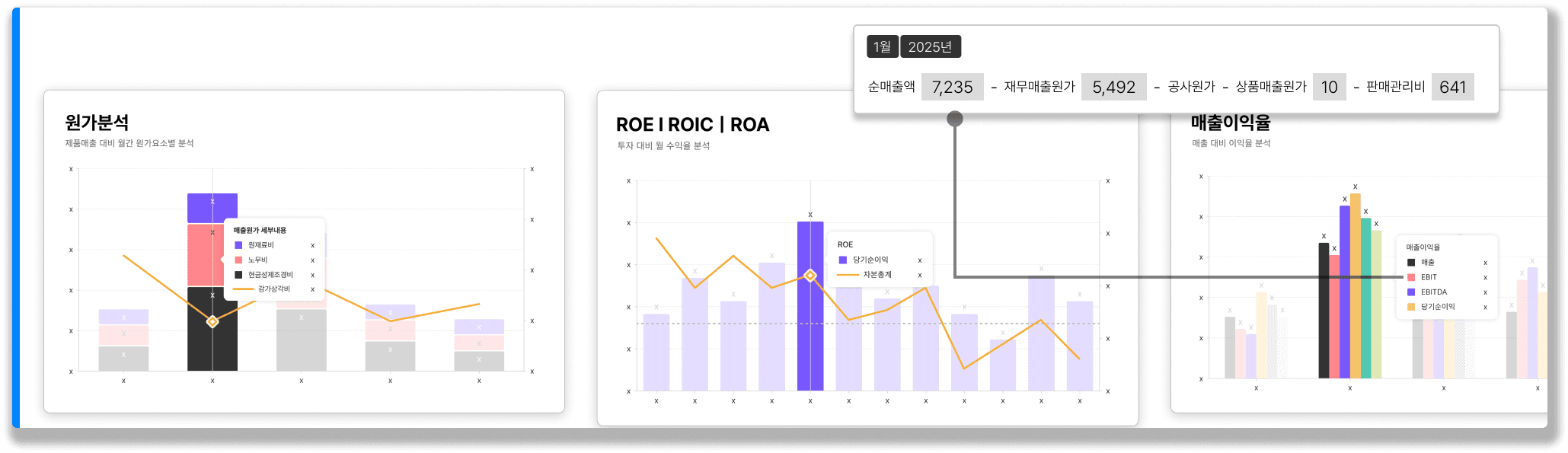
Your company's value has to be something you can both "calculate" and "explain" before you can convince anyone else of it. Calculate your company's value precisely with fiela.ai, and manage it with Numen! ↓↓
🤖 fiela.ai — Try the AI valuation calculator
📊 Numen AI — Manage your financial data and run financial forecasts
✨⚙️ Want to bring FP&A AI into your finance function?
Get FP&A insights validated on the floor — delivered every Tuesday morning.

![[Q&A] What Does Management Accounting Actually Tell You?](https://framerusercontent.com/images/o4dLsLAp4uFm9AqsdEaR5ODBhZY.jpg)
![[Q&A] Can You Do FP&A Without a Dedicated Team?](https://framerusercontent.com/images/TelYmjwSpuKtqbtPQ8c9GQvahCc.jpg)